I’ve been deliberately quiet about the adaptation — for reasons that will make sense to anyone who has watched a promising film project get talked up and then altered beyond recognition. You manage expectations, or expectations manage you. So I said very little while the work was happening, and now that it’s finished, I want to say something.
Working with Luca Bertani was not what I anticipated, and what I anticipated was not good. I’ve had conversations with directors before — earlier in my career, when the rights to Blast Radius were optioned the first time and nothing came of it — and the pattern was familiar: enthusiasm for the material, followed by a gradual, incremental negotiation over which parts of it actually mattered. By the time the process was finished, the thing being made had very little to do with the thing that existed on the page.
That did not happen here.
What Luca brought to the production — and I watched enough of it to have an opinion — was a refusal to reduce. He had read not just Blast Radius but all seven books that followed it, and he understood that what the series is actually about is not action. It’s about decision-making under incomplete information, with action as the visible consequence of that process. He held that distinction across eighteen months of production. It shaped everything: how he staged scenes, what he chose to cut, where he put the camera when there was nothing happening and someone was simply thinking.
Vienna
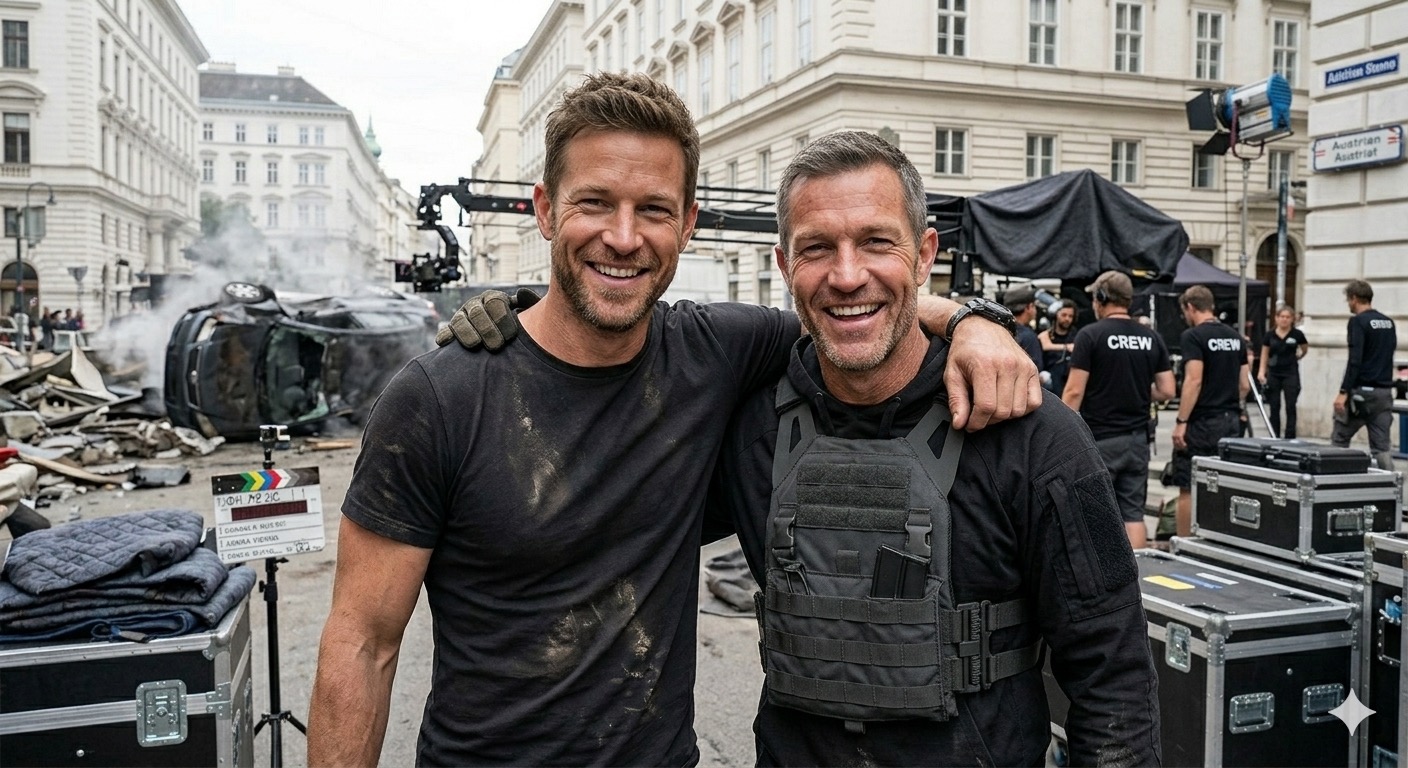
The action sequences were shot over fourteen days in Vienna — the Westbahnhof, the canal, a stretch of the Ring I won’t describe because you should encounter it without preparation. I was on set for most of those days. Vienna is a city that rewards the camera in ways that aren’t obvious from the outside: it has a quality of formality over concealed disorder that fits the Knox world very well. Bertani saw that. The sequences he built there are the part of the film I’m least prepared to talk about in advance, which is the best thing I can say about any part of a film.
The rest of production moved through Prague, London, and the Faroe Islands — the last of which was not in the source material and was entirely Luca’s idea. He was right.
Knox
The casting question was the one I was asked most often during production, usually by people trying to figure out whether I was happy about it and not wanting to ask directly. I’ll be direct: when Declan Rourke was announced, I was uncertain. I want to be honest about that, because what came after deserves honest context.
My uncertainty wasn’t about Rourke’s ability — his work speaks for itself. It was about fit. Knox is not an action hero in the way the genre has trained audiences to read that term. He is not a man who dominates physical situations through superiority. He is a man who survives them through economy — through doing exactly what is necessary and nothing else, arriving at the right moment rather than controlling the room. That is a harder thing to film than it sounds, and a harder thing to cast.
Rourke understood this. He had read everything published before our first meeting — not as research, or not only as research, but because he had wanted to. He came to that meeting with specific questions, not about action sequences or character backstory, but about Knox’s silences. What was Knox doing, cognitively, in the moments when he wasn’t acting? What was he tracking? That’s the right question. It’s the question the books live in, and the fact that Rourke was asking it told me what I needed to know.
On the physical side: Rourke pushed, consistently, to do more than Bertani would sanction. Luca is not a director who uses stunt work as a default — he will put an actor in the situation if the actor is capable and the risk is manageable — but he also has a production to protect and a schedule that doesn’t accommodate injury. The negotiation between them, from what I observed, was ongoing and specific. Rourke did not win all of it. He won enough. The sequences where you are watching the actor and not a double are visible on screen — not because they are showy, but because there is a quality of attention in them that changes. You can see Rourke thinking. In those moments, he is Knox in a way I did not fully anticipate.
I was wrong to be uncertain. I want to say that plainly.
The Crew
I want to say this plainly and not bury it in qualifications: the crew on this production were exceptional. Every department. These were people who had done the reading, who understood what kind of film they were making and treated that understanding as a professional obligation rather than a suggestion. On a production this size, spread across four countries over a year and a half, that kind of coherent intention is rare. I watched it hold.
I won’t list names here because the list would be too long and any list I made would leave someone out who didn’t deserve to be. You’ll see the credits when the film opens.
Summer 2027
Blast Radius is scheduled for Summer 2027. Work continues — scoring, effects, the thousand things that happen after principal photography wraps and before a film exists in a form the public can see. I’ll say more as it’s appropriate to say more.
The official trailer is above. I’ve watched it more times than I want to admit. It holds up.